
What is a Spousal IRA?
January 28, 2026
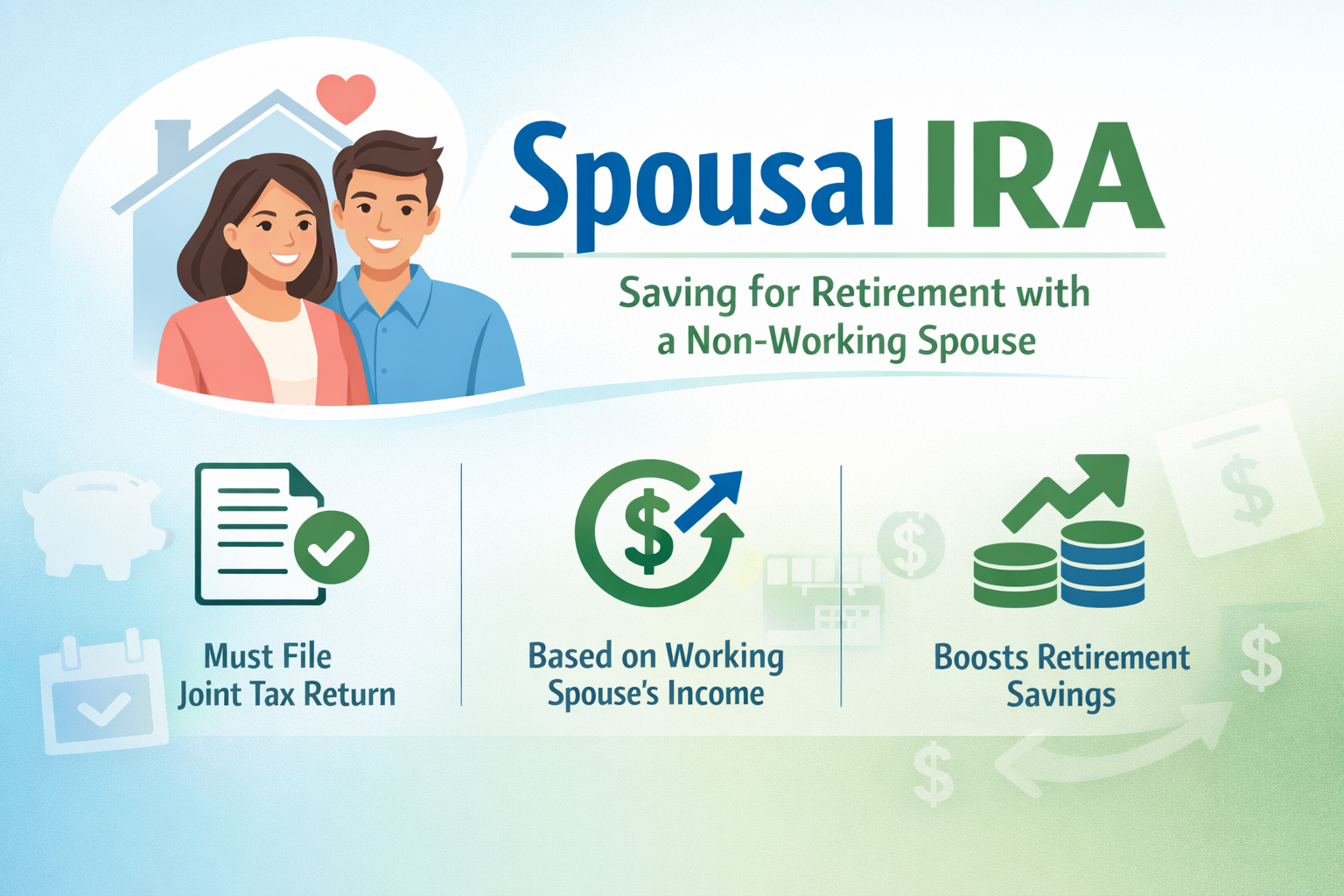
Most retirement accounts require earned income in order to contribute. However, there is a notable exception for married couples: the spousal IRA. This provision allows a nonworking spouse to build retirement savings using the working spouse’s income. While it is not a separate type of IRA under the tax code, a spousal IRA follows specific eligibility and contribution rules that make it a valuable planning tool for households with a single income earner.
Below is a practical breakdown of how spousal IRAs work, the different account types available, and strategies for using them effectively as part of a long-term retirement plan.
Understanding Spousal Traditional IRAs
A spousal traditional IRA allows a nonworking spouse to save for retirement even without personal earned income. Contributions are made using household income generated by the working spouse. Like a standard traditional IRA, the account offers tax-deferred growth, meaning investments grow without current taxation, and income taxes are paid when funds are withdrawn in retirement.
In some cases, contributions may be tax-deductible. Deductibility depends on whether the working spouse participates in an employer-sponsored retirement plan and on the couple’s modified adjusted gross income (MAGI). When eligible, the deduction provides an immediate tax benefit while still allowing long-term compounding inside the account.
Understanding Spousal Roth IRAs
A spousal Roth IRA functions similarly to a standard Roth IRA, but is opened in the nonworking spouse’s name and funded using household income. Contributions are made with after-tax dollars, meaning they are not deductible. The benefit comes later: qualified withdrawals in retirement—including investment gains—can be federally tax-free if IRS requirements are met.
Eligibility to contribute is based on the same income thresholds that apply to standard Roth IRAs. Each spouse may also maintain and fund their own Roth IRA, subject to the same household income limits.
Key Rules That Govern Spousal IRAs
Spousal IRAs are governed by several important requirements:
● Joint tax filing is mandatory. Couples must file as married filing jointly. Those filing separately are not eligible to use a spousal IRA strategy.
● Standard IRA limits apply. Contribution caps and income thresholds are identical to regular traditional and Roth IRAs.
● Roth income limits apply. Eligibility to contribute to a spousal Roth IRA phases out at higher income levels based on MAGI.
● Deductibility rules apply to traditional IRAs. If the working spouse has a workplace retirement plan, deductions may be limited or unavailable depending on household income.
● Ownership is individual. The account belongs solely to the nonworking spouse. There is no such thing as a joint IRA. The account holder controls investments, beneficiaries, and withdrawals, even if contributions come from the working spouse’s income.
● Funding deadline. Contributions for a tax year may be made up until the tax filing deadline of the following year, typically April 15.
Contribution Limits
Spousal IRAs follow the same annual contribution limits as all IRAs:
● 2025: $7,000 per person
● 2026: $7,500 per person
● Catch-up contributions: Individuals age 50 and older may contribute additional amounts beyond the base limit.
These limits apply across all IRA accounts per person. For example, contributions split between a spousal traditional IRA and a spousal Roth IRA must still stay within the annual cap. Household earned income must be sufficient to cover contributions for both spouses.
How to Open a Spousal IRA
The process is straightforward:
1. Select a financial institution
Choose a brokerage firm, bank, or financial provider that offers IRAs. Many couples prefer using the same institution where other accounts are already held for simplicity and integration.
2. Complete account setup
The nonworking spouse opens the account in their own name and provides standard personal identification and tax information.
3. Choose account type
Decide between a traditional IRA and a Roth IRA based on tax strategy, income eligibility, and long-term planning goals.
4. Fund the account
Contributions can come from household income or existing savings and are typically funded via bank transfers or direct deposits.
5. Allocate investments
Funds can be invested in diversified portfolios based on time horizon, risk tolerance, and retirement objectives. Portfolio management should be reviewed periodically as circumstances evolve.
Strategies to Maximize the Value of a Spousal IRA
Start early
Time in the market is one of the most powerful drivers of retirement growth. Even modest annual contributions can compound meaningfully over decades.
Prioritize consistency
Regular contributions—even below the maximum—build momentum and establish disciplined saving habits.
Use tax diversification
Balancing traditional and Roth accounts can provide flexibility in retirement by creating multiple tax treatment options for future income planning.
Support Social Security planning
Supplemental retirement savings may allow couples to delay Social Security benefits, potentially increasing long-term income security.
Strategic Perspective
Spousal IRAs allow couples to build retirement equity for both partners, even when only one spouse is earning income. This creates financial independence, improves household resilience, and strengthens long-term planning flexibility. When integrated properly with workplace plans, taxable investment accounts, and Social Security strategies, spousal IRAs become a core pillar of comprehensive retirement planning.
Sources:
https://www.fidelity.com/learning-center/investment-products/spousal-ira
Disclosure:
This information is an overview and should not be considered as specific guidance or recommendations for any individual or business.
This material is provided as a courtesy and for educational purposes only.
These are the views of the author, not the named Representative or Advisory Services Network, LLC, and should not be construed as investment advice. Neither the named Representative nor Advisory Services Network, LLC gives tax or legal advice. All information is believed to be from reliable sources; however, we make no representation as to its completeness or accuracy. Please consult your Financial Advisor for further information.