
You Retired in Your Early 50’s. Your $1M+ IRA Could Be a Tax Opportunity.
If you’re in your early 50s, not working, and sitting on a large IRA — you’re in a more powerful tax planning position than you probably realize. The question is whether you’re using it.
May 26, 2026

In This Article:
• Why stopping work in your early 50s may create a rare, time-limited tax planning opportunity
• How Roth conversions work — and why low-income years may be a good time to execute them
• A Critical Concern: Until age 59½, Conversion Taxes Taken from the IRA Create Penalties
• Why “I’ll be in a lower bracket in retirement” can be the most expensive assumption in financial planning
• What a $1M IRA can look like at age 73 if left untouched — and what it costs you
• Social Security timing, ACA health coverage, and how they interact with your conversion strategy
Here’s something most people may not fully appreciate: the years between when you stop working and when the government forces you to start taking money out of your IRA may be the most valuable tax planning window of your entire financial life.
If you retired in your early 50s with a $1M+ IRA and no earned income, your taxable income right now is probably very low — maybe the lowest it’s been since your 20s. That feels comfortable. But what most people don’t see is the tax liability quietly compounding inside that IRA, growing larger every year, and waiting to be unleashed at the worst possible moment.
Every dollar in your traditional IRA is money the IRS has never touched. It will all be taxed as ordinary income eventually — either by you, on your schedule, or by the government through Required Minimum Distributions starting at age 73. The question isn’t whether you’ll pay the tax. It’s whether you’ll pay it strategically or reactively.
The window you have right now is genuinely rare. Here’s how to use it.
1. You’re in a Low-Income Window. That’s Not a Problem — It’s the Opportunity.
When you were working, your income likely pushed you into the 22%, 24%, or higher federal tax brackets. Now that you’ve stopped working, your taxable income may have dropped dramatically. If you’re living off savings or a taxable brokerage account, you might be reporting very little ordinary income at all.
People may see this as simply “not earning money.” Depending on your specific situation, it could be an opportunity to move money out of your IRA at historically low tax rates — intentionally, strategically, and on your terms — before the government sets the terms for you.
This window has a natural endpoint. Once Social Security starts, it layers onto your income. Once RMDs begin at 73, they layer on more — whether you want them to or not. The low-income years of early retirement are finite. They are also, for IRA planning purposes, irreplaceable.
The Core Insight:
Your early retirement years aren’t just a quiet period before income picks back up. They’re the lowest-cost years you will ever have to pay taxes on your IRA money. Every year you don’t act is a year of that opportunity you can’t get back.
2. The Roth Conversion: A Useful Tool
A Roth conversion is simple in concept: you move money from your traditional IRA into a Roth IRA, pay income tax on the converted amount in the current year, and in return that money grows and withdraws tax-free for the rest of your life subject to certain rules.
The reason this strategy is so powerful for someone in your situation is timing. You’re likely in a low tax bracket. You have years — possibly more than a decade — before Social Security starts, before RMDs begin, before other income sources layer on top of each other and push you into higher territory. Converting now means you pay tax at today’s low rates on dollars that would otherwise be taxed at higher rates later.
What Roth Conversions Actually Accomplish
• They shrink your future traditional IRA balance, which directly shrinks your future RMDs.
• They move money into a tax-free environment — all future growth is never taxed again.
• They give you a pool of tax-free income in retirement, giving you control over your taxable income in any given year.
• They can reduce how much of your Social Security benefit is subject to taxation.
• They can reduce or eliminate Medicare IRMAA surcharges, which are driven by reported income.
• Heirs inherit Roth IRAs with no immediate tax obligation — a significant estate planning benefit.
How Much to Convert Each Year
The optimal conversion amount depends on your specific situation — current income from any source, other deductions, filing status, state taxes, ACA coverage — but the general framework is to convert up to the top of your current tax bracket without crossing into the next one. For many early retirees with little other ordinary income, this could mean converting $50,000 to $150,000 per year at 12% or 22% federal rates.
What $1M Becomes Without Action:
A $1M IRA growing at 6% annually reaches approximately:
• $1.34M by age 60
• $1.79M by age 65
• $3.20M by age 73 — when RMDs begin
At $3.2M, the first year’s Required Minimum Distribution is roughly $120,000+ — fully taxable as ordinary income, whether you need the money or not. That could push you into the 24–32% bracket. And RMDs grow larger every year, not smaller.
The “do nothing” strategy is itself a strategy. Just not a good one.
This is intended for illustrative purposes only and does not represent any specific investment or strategy. Your results will vary.
3. Critical Rule: Until Age 59½, Conversion Taxes Taken From the IRA Create Penalties
This is the detail that catches people off guard, and it matters: when you do a Roth conversion, the income tax owed on the converted amount will create penalties if withdrawn from your IRA — at least until you turn 59½.
If you pull money from the IRA itself to cover the tax bill, that additional withdrawal counts as a separate taxable distribution — and if you’re under 59½, it’s also subject to a 10% early withdrawal penalty. You’d be paying tax on your tax payment, and adding a penalty on top of it. The math falls apart quickly.
Practical Example:
You’re 54 and convert $80,000 from your IRA to a Roth. In the 22% bracket, you owe roughly $17,600 in federal income taxes. That $17,600 must come from your savings or taxable brokerage account — not from the IRA. If it comes from inside the IRA, you’ve withdrawn an extra $17,600, owe income tax on that too, and owe a $1,760 early withdrawal penalty on top. You’ve made an expensive mistake trying to do something smart.
This is intended for illustrative purposes only and does not represent any specific investment or strategy. Your results will vary.
This means successful Roth conversion planning before 59½ can require having an accessible pool of non-IRA assets to fund the tax bill each year. If you’re currently living off a taxable brokerage account or cash savings, that’s exactly the right setup — those are your conversion tax funds. The key is coordinating how much you convert with how much tax liquidity you have available.
After Age 59½:
The 10% early withdrawal penalty disappears. You gain more flexibility, though paying conversion taxes from outside the IRA remains the more efficient approach when possible — it preserves the full converted amount inside the Roth rather than recycling IRA money to pay for itself.
4. The Myth Costing Retirees Thousands: “I’ll Be in a Lower Bracket in Retirement”
This is perhaps the single most common — and most costly — assumption in retirement planning. The idea is intuitive: you stop working, your income drops, your tax rate drops. It sounds logical. For households with large IRAs, it’s often wrong.
The Income That Shows Up Uninvited
Once you reach age 73, the IRS doesn’t care whether you need money from your IRA. Required Minimum Distributions are calculated based on your account balance and IRS life expectancy tables — and they’re taxed as ordinary income whether you spend the money, reinvest it, or give it away.
Layer that on top of Social Security income — up to 85% of which becomes taxable above certain income thresholds — and a “retired” household can suddenly find itself reporting $150,000, $180,000, or more per year in ordinary taxable income. Often more than they reported while working.
The Medicare Surcharge Most Retirees Never See Coming
Medicare Part B and Part D premiums are income-adjusted. Once your income crosses certain thresholds, your premiums can jump by hundreds of dollars per month. These surcharges — called IRMAA — are based on income from two years prior, meaning your IRA distributions at 73 affect your Medicare costs at 75. It’s a delayed tax hit most people never plan for.
The Reality for Many Early Retirees With Large IRAs:
Early 50s: Little or no ordinary income. Potentially the lowest tax brackets of their adult life.
Age 62–69: Social Security eligible but not yet claimed (ideally). Income still relatively controlled.
Age 73+: RMDs mandatory. Social Security taxed up to 85%. Medicare surcharges apply. Taxable ordinary income often exceeds working years.
The “lower bracket in retirement” assumption was built on a picture of early retirement. It breaks down at 73. Roth conversions in your early 50s and 60s are specifically designed to prevent this outcome.
5. Social Security: Don’t Touch It Yet
If you’re in your early 50s, Social Security is at least 9–18 years away. That’s good news from a planning standpoint — you have time to build strategy around it rather than simply react to it.
The single most impactful Social Security decision most people make is when to claim. The math is clear:
• Claim at 62: You receive approximately 70–75% of your full benefit — locked in for life.
• Claim at Full Retirement Age: You receive 100%.
• Claim at 70: You receive 124–132% of your full benefit, plus annual cost-of-living increases.
For a household that retired early and has other assets to live on, delaying Social Security to 70 is frequently the right call. Delaying past full retirement age provides roughly a 7–8% guaranteed annual increase in benefit for every year you wait. That’s an inflation-adjusted, government-backed return with no market risk.
Why This Connects Directly to Your Roth Strategy
The years between now and when you claim Social Security are your cleanest Roth conversion window. Once Social Security starts, it becomes part of your income picture and narrows the bracket space available for conversions without triggering higher taxes. The more aggressively you convert before Social Security begins, the more flexibility you have after it starts.
For Married Couples:
Social Security survivor benefits are often the most underplanned piece of a retirement income strategy. The higher-earning spouse delaying to 70 can mean a significantly larger benefit for the surviving spouse — potentially for decades. This tradeoff deserves careful modeling, not a default decision made at 62 out of convenience.
6. The ACA Factor: One More Variable to Manage Before Medicare
If you retired before age 65, you’re not yet eligible for Medicare. That means you’re likely purchasing health insurance through the ACA marketplace, and your premium subsidies are directly tied to your reported taxable income.
This creates an important planning tension: Roth conversions increase your taxable income in the year you execute them, which can reduce ACA subsidies or eliminate them entirely. Depending on your healthcare costs and subsidy level, this tradeoff can be significant. A conversion that saves $15,000 in future taxes might cost $8,000 to $12,000 in lost ACA subsidies that year. The full math has to be run.
The right answer isn’t to avoid conversions — it’s to size them in a way that accounts for the complete picture: federal taxes, state taxes, and ACA subsidy impact together. For many early retirees this means converting up to a specific income threshold rather than simply filling a federal tax bracket.
Age 65 and Medicare:
Once you move onto Medicare, the ACA variable disappears and the Roth conversion window often opens wider. Many retirees find that ages 65–72 are their most productive conversion years — ACA constraints are gone, Social Security may not have started, and RMDs are still years away.
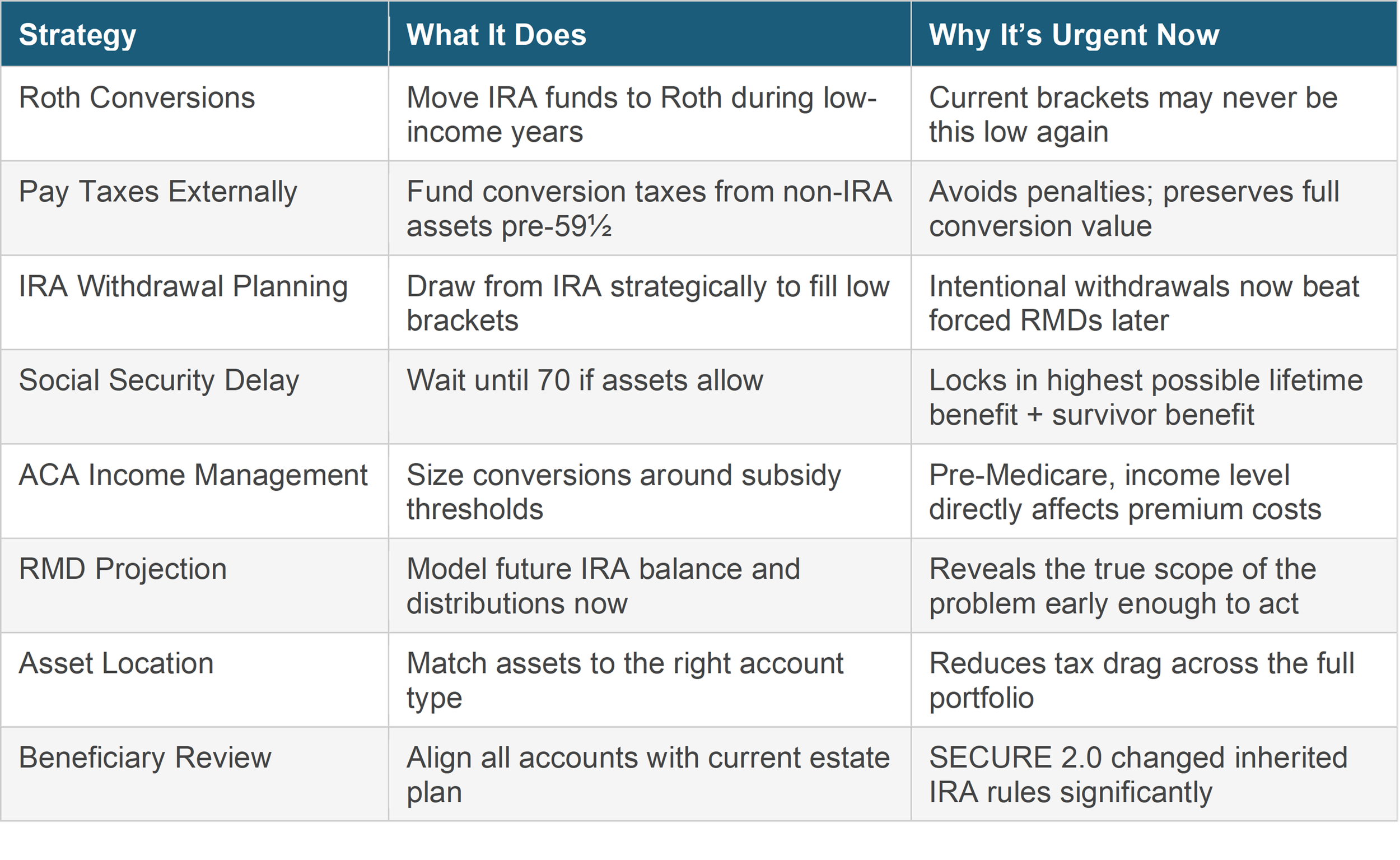
Your Early-Retirement Planning Framework at a Glance
7. What “Doing Nothing” Actually Costs
It’s tempting to leave the IRA alone. It’s growing. It feels like a success. And there’s no immediate pressure to act.
But every year you’re in a low tax bracket without doing conversions is a year the embedded tax bill grows inside the IRA — compounding right alongside the principal. The IRS’s share of your account gets larger every year you wait. Inaction isn’t a neutral choice. It’s a vote for paying higher taxes later.
The Cost of Waiting — A Simplified Illustration:
Assume a $1.2M IRA at age 53, growing at 6%. Two paths:
Path A — Convert aggressively for 10 years: Pay taxes now at 22%. Roth grows tax-free. Future RMDs are dramatically reduced. Over a 30-year retirement, estimated total tax savings vs. Path B: $200,000–$400,000+, depending on account growth and bracket exposure.
Path B — Leave the IRA alone: Account reaches ~$3.5M by 73. Annual RMDs of $130,000+, taxed as ordinary income. Social Security partially taxed. Medicare surcharges likely for years. Brackets of 24–32%+ persist for decades.
The difference isn’t hypothetical. It’s the predictable mathematical consequence of when you pay the tax.
This is intended for illustrative purposes only and does not represent any specific investment or strategy. Your results will vary.
A Final Word
Retiring in your early 50s with a $1M+ IRA is a remarkable position to be in. But the tax liability embedded in that account is real, it’s growing, and it has a timer on it.
The years between now and age 73 — when Required Minimum Distributions become mandatory — are your window to reshape how that tax plays out. The specific years when your income is lowest are the most valuable of all. This window doesn’t stay open. Social Security will start. RMDs will arrive. Income layers on.
The households that come out ahead aren’t always the ones who earned the most. They’re the ones who paid their taxes on the most favorable terms possible.
Sources
All factual claims in this article are drawn from primary government sources, peer-reviewed publications, and established financial institutions.
Required Minimum Distributions (RMDs)
1. Internal Revenue Service. “Retirement Topics — Required Minimum Distributions (RMDs).” IRS.gov. https://www.irs.gov/retirement-plans/plan-participant-employee/retirement-topics-required-minimum-distributions-rmds
2. Internal Revenue Service. “Retirement Plan and IRA Required Minimum Distributions FAQs.” IRS.gov. https://www.irs.gov/retirement-plans/retirement-plan-and-ira-required-minimum-distributions-faqs
3. Congressional Research Service. “Required Minimum Distribution Rules for Original Owners of Retirement Accounts.” Congress.gov. IF12750. https://www.congress.gov/crs-product/IF12750
4. Internal Revenue Service. “Publication 590-B: Distributions from Individual Retirement Arrangements (IRAs).” IRS.gov. https://www.irs.gov/publications/p590b
5. Federal Register. “Required Minimum Distributions.” 89 Fed. Reg. 58886 (July 19, 2024). https://www.federalregister.gov/documents/2024/07/19/2024-14542/required-minimum-distributions
Early Withdrawal Penalty & Roth Conversion Rules
6. Internal Revenue Service. “Topic No. 557: Additional Tax on Early Distributions from Traditional and Roth IRAs.” IRS.gov. https://www.irs.gov/taxtopics/tc557
7. Internal Revenue Service. “Retirement Plans FAQs Regarding IRAs.” IRS.gov. https://www.irs.gov/retirement-plans/retirement-plans-faqs-regarding-iras
8. Fidelity Investments. “What Is the Roth IRA 5-Year Rule?” Fidelity.com. https://www.fidelity.com/learning-center/personal-finance/retirement/roth-ira-5-year-rule
9. Charles Schwab. “What to Know About the Five-Year Rule for Roths.” Schwab.com. https://www.schwab.com/learn/story/what-to-know-about-five-year-rule-roths
10. Vanguard. “IRA Withdrawal Rules.” Vanguard.com. https://investor.vanguard.com/investor-resources-education/iras/ira-withdrawal-rules
Social Security Claiming & Delayed Retirement Credits
11. Social Security Administration. “Benefits Planner: Retirement Age and Benefit Reduction.” SSA.gov. https://www.ssa.gov/benefits/retirement/planner/agereduction.html
12. Social Security Administration. “Benefits Planner: Delayed Retirement Credits.” SSA.gov. https://www.ssa.gov/benefits/retirement/planner/delayret.html
13. Social Security Administration. “Delayed Retirement (Born in 1960).” SSA.gov. https://www.ssa.gov/benefits/retirement/planner/1960-delay.html (124% benefit at 70 for FRA 67 cohort)
14. Social Security Administration. “Delayed Retirement (Born Between 1943 and 1954).” SSA.gov. https://www.ssa.gov/benefits/retirement/planner/1943-delay.html (132% benefit at 70 for FRA 66 cohort)
15. Social Security Administration. “Incentivizing Delayed Claiming of Social Security Retirement Benefits.” Social Security Bulletin, Vol. 74, No. 4. SSA.gov. https://www.ssa.gov/policy/docs/ssb/v74n4/v74n4p21.html
16. Congressional Research Service. “Social Security: Adjustment Factors for Early or Delayed Benefit Claiming.” R47151. Congress.gov.
Taxation of Social Security Benefits
17. Internal Revenue Service. “Publication 915: Social Security and Equivalent Railroad Retirement Benefits.” IRS.gov. https://www.irs.gov/publications/p915
18. Congressional Research Service. “Social Security Benefit Taxation.” IF11397. Congress.gov. https://www.congress.gov/crs-product/IF11397 (85% taxability threshold: single filers >$34,000; joint filers >$44,000)
19. Congressional Research Service. “Taxation of Social Security Benefits.” R48613. Congress.gov. https://www.congress.gov/crs_external_products/R/HTML/R48613.html
20. T. Rowe Price. “What to Know About Social Security Benefits and Your Taxes.” TRowePrice.com. https://www.troweprice.com/en/us/personal-investing/insights/the-impact-of-social-security-benefits-on-your-taxes
Medicare IRMAA Surcharges
21. Kiplinger. “Medicare Premiums 2025: IRMAA Brackets and Surcharges for Parts B and D.” Kiplinger.com. https://www.kiplinger.com/retirement/medicare/medicare-premiums-2025-irmaa-for-parts-b-and-d (2025 IRMAA threshold: individual >$106,000; joint >$212,000, based on 2023 MAGI)
22. Social Security Administration. “IRMAA Sliding Scale Tables.” POMS HI 01101.020. SSA.gov. https://secure.ssa.gov/poms.nsf/lnx/0601101020
23. MedicareResources.org. “What Is the Income-Related Monthly Adjusted Amount (IRMAA)?” https://www.medicareresources.org/medicare-eligibility-and-enrollment/what-is-the-income-related-monthly-adjusted-amount-irmaa (2026 threshold: individual >$109,000; joint >$218,000)
About Olde Raleigh Financial Group
Olde Raleigh Financial Group is an independent, fee-based fiduciary advisory firm in Raleigh, NC. We specialize in tax-efficient retirement income planning for individuals and families who have retired early or are approaching retirement with significant IRA and investment assets.
Advisory services offered through Olde Raleigh Financial Group, A Member of Advisory Services Network, LLC. All information contained herein is derived from sources deemed to be reliable but cannot be guaranteed. All views/opinions expressed in this newsletter are solely those of the author and do not reflect the views/opinions held by Advisory Services Network, LLC.
Disclosure: This article is for informational and educational purposes only and does not constitute personalized investment, tax, or legal advice. All investing involves risk, including the possible loss of principal. Tax strategies discussed may not apply to your individual situation. IRA conversion tax consequences vary based on individual circumstances, filing status, and applicable law. Consult a qualified tax advisor or financial professional before implementing any strategy. Olde Raleigh Financial Group and Advisory Services Network LLC are not affiliated with any government agency.