
After-Tax 401(k) Contributions: Rules, Taxes & Rollovers
June 3, 2026
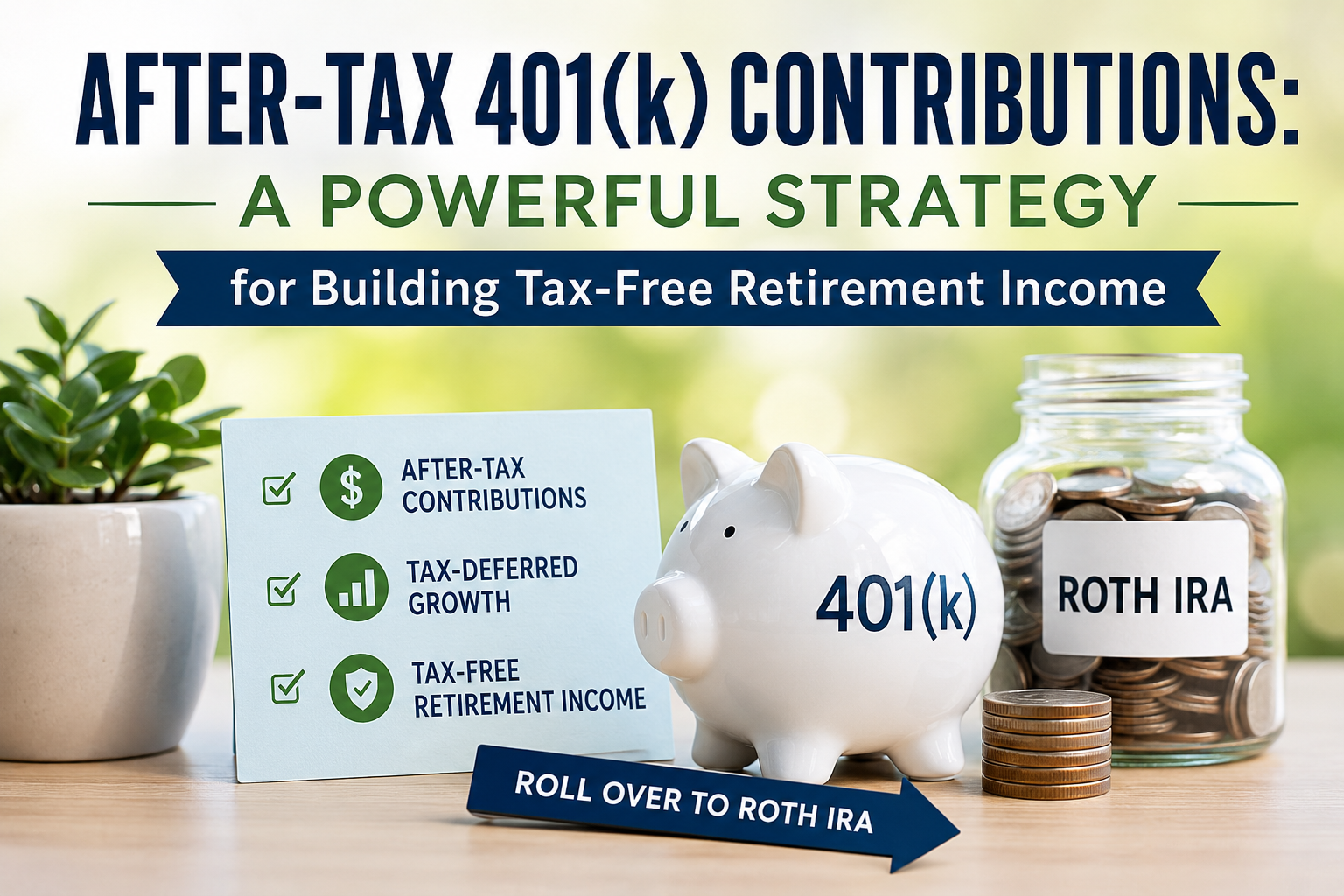
Workplace retirement plans, like 401(k)s, offer tax benefits. But how your savings are taxed depends on the type of contributions you make. Understanding the different contribution categories and how withdrawals are treated can help you make more informed decisions about retirement income and rollover strategies.
Understanding the Three Types of Retirement Plan Contributions
Many employer-sponsored retirement plans allow participants to contribute in one or more of the following ways: traditional pre-tax contributions, Roth contributions, and after-tax contributions.
Pre-tax contributions are deducted from your paycheck before federal income taxes are applied. Employer matching contributions and profit-sharing deposits are generally made on a pre-tax basis as well. Because taxes are deferred, withdrawals of both contributions and investment earnings are typically taxed as ordinary income when distributed during retirement.
Roth contributions work differently. These contributions are made with money that has already been taxed, so they do not reduce current taxable income. In exchange, qualified withdrawals of Roth contributions and their earnings can be taken tax-free during retirement, provided IRS requirements are met.
After-tax contributions share characteristics of both traditional and Roth accounts. Like Roth contributions, they are made with after-tax dollars and can be withdrawn tax-free. However, any earnings generated by those contributions grow tax-deferred and are generally taxable when withdrawn.
Contribution Limits for 2026
For 2026, employees may contribute up to $24,500 in combined pre-tax and Roth salary deferrals to eligible workplace retirement plans. In addition, some plans permit after-tax employee contributions beyond that amount.
When employee contributions, employer matching contributions, profit-sharing contributions, and after-tax contributions are combined, the overall annual limit is $72,000 for 2026.
Participants age 50 and older can make an additional catch-up contribution of up to $8,000. Workers between ages 60 and 63 may qualify for an enhanced catch-up contribution limit of $11,250.
One important rule to note: individuals whose FICA wages exceeded $150,000 in 2025 must make catch-up contributions on a Roth basis beginning in 2026.
How Earnings on After-Tax Contributions Are Taxed
While after-tax contributions themselves can generally be withdrawn without additional taxation, the earnings associated with those contributions receive different treatment.
Because taxes have already been paid on the original contributions, those amounts are not taxed again when distributed. However, the investment growth generated by those contributions is considered pre-tax money and is generally subject to ordinary income tax upon withdrawal.
This distinction is important because it creates planning opportunities. Moving after-tax contributions into a Roth account can potentially allow future earnings to grow and eventually be withdrawn tax-free, assuming applicable rules are satisfied.
Moving After-Tax Contributions to a Roth IRA
Employees with after-tax assets inside a 401(k), 403(b), or similar retirement plan may be able to transfer those after-tax dollars directly into a Roth IRA without creating a tax bill on the contributions themselves.
At the same time, any pre-tax funds—including earnings associated with after-tax contributions—can be rolled into a traditional IRA.
Although the tax treatment can be separated during a rollover, your ability to access specific portions of the account depends on your employer's plan rules. Some plans permit withdrawals from particular contribution sources, while others require distributions to include a proportional mix of all account balances.
Under current IRS rules:
● After-tax contributions may be rolled into a Roth IRA.
● Pre-tax balances and earnings may be rolled into a traditional IRA.
● A single distribution can be divided among multiple IRA types based on the tax characteristics of the assets.
However, plan documents ultimately determine whether partial withdrawals or source-specific withdrawals are allowed.
Common Rollover Scenarios
Complete Account Rollover
When the entire retirement plan balance is transferred, after-tax contributions can be directed to a Roth IRA, while pre-tax assets and earnings can be moved into a traditional IRA. A properly executed direct rollover generally avoids current taxation.
Partial Distribution with Source-Specific Access
If the plan allows withdrawals from a specific contribution source, participants may be able to withdraw only the after-tax portion of the account. The after-tax contributions can then be moved into a Roth IRA, while any related earnings are transferred to a traditional IRA.
Investors holding employer stock should be aware that certain withdrawals could affect eligibility for Net Unrealized Appreciation (NUA) tax treatment.
Example of an After-Tax Rollover
Consider a retiree named Andrew, age 60, who has accumulated $1 million in a 401(k):
● $800,000 consists of pre-tax money.
● $200,000 represents after-tax contributions.
● $100,000 of the pre-tax balance reflects earnings generated by those after-tax contributions.
If his plan permits source-specific distributions, Andrew could withdraw the entire after-tax source totaling $300,000. He could then move the $200,000 contribution portion into a Roth IRA and roll the $100,000 earnings portion into a traditional IRA.
If the plan does not allow source-specific withdrawals, any partial distribution would generally include a proportional combination of both pre-tax and after-tax assets. He could still direct each portion to the appropriate IRA, but he would not be able to isolate only the after-tax contributions before the distribution occurs.
Factors to Consider Before Rolling Over Retirement Assets
Some employers allow participants to convert after-tax contributions directly into a Roth 401(k) within the company plan. In certain situations, an in-plan Roth conversion may be worth considering instead of moving assets to an IRA.
When evaluating your options, several factors may come into play:
Investment Flexibility
Roth IRAs often provide access to a broader range of investments than many workplace retirement plans. On the other hand, employer-sponsored plans may offer institutional pricing or specialized investment options unavailable to individual investors.
Required Minimum Distributions
Unlike traditional retirement accounts, Roth IRAs are not subject to required minimum distributions during the owner's lifetime.
Withdrawal Options
Roth IRAs may offer greater flexibility for accessing funds under certain circumstances. Depending on age, account history, and IRS rules, distributions may be available for qualified expenses such as a first-time home purchase or educational costs.
Reasons to Keep Assets in a 401(k)
A rollover is not always the best choice. There can be meaningful advantages to leaving assets inside an employer-sponsored retirement plan:
● Access to institutionally priced investment options.
● Strong federal creditor protection under ERISA.
● Potential loan provisions while still employed.
● Preservation of certain tax strategies involving company stock, including Net Unrealized Appreciation (NUA).
Evaluate All Available Options
The decision to roll money out of a workplace retirement plan involves more than just taxes. Investment choices, creditor protection, withdrawal flexibility, fees, employer-plan features, and estate-planning considerations should all be evaluated carefully.
Before moving retirement assets, review your plan's rules, and compare other options. Consider talking with a qualified tax professional or financial advisor. They can help you choose the approach that fits your retirement strategy.
Sources:
https://www.fidelity.com/viewpoints/retirement/IRS-401k-rollover-guidance
Disclosure:
This information is an overview and should not be considered as specific guidance or recommendations for any individual or business.
This material is provided as a courtesy and for educational purposes only.
These are the views of the author, not the named Representative or Advisory Services Network, LLC, and should not be construed as investment advice. Neither the named Representative nor Advisory Services Network, LLC gives tax or legal advice. All information is believed to be from reliable sources; however, we make no representation as to its completeness or accuracy. Please consult your Financial Advisor for further information.