
Investment Mix: Risk, Time Horizon & Stability
March 4, 2026
March 4, 2026
Investing in the markets can help you reach long-term financial goals. These may include saving for retirement, buying a home, or paying for education. However, before choosing investments, or relying on an advisor, it helps to pause.
Clarify a few basic points first. These key questions will guide your strategy. They will help you build a portfolio that fits your needs, capacity, and comfort level.
Key Questions to Ask Before Investing
How would you react to a market downturn?
Imagine your portfolio dropping 30% in a short period due to a market decline. Would you remain calm and continue investing, or would you feel compelled to sell? Your investment strategy should reflect not just what you can afford to risk financially, but also what you can tolerate emotionally. Understanding your response to market swings is critical because it can determine whether you stick with your plan or make impulsive decisions that undermine your long-term goals.
What does your overall financial situation look like?
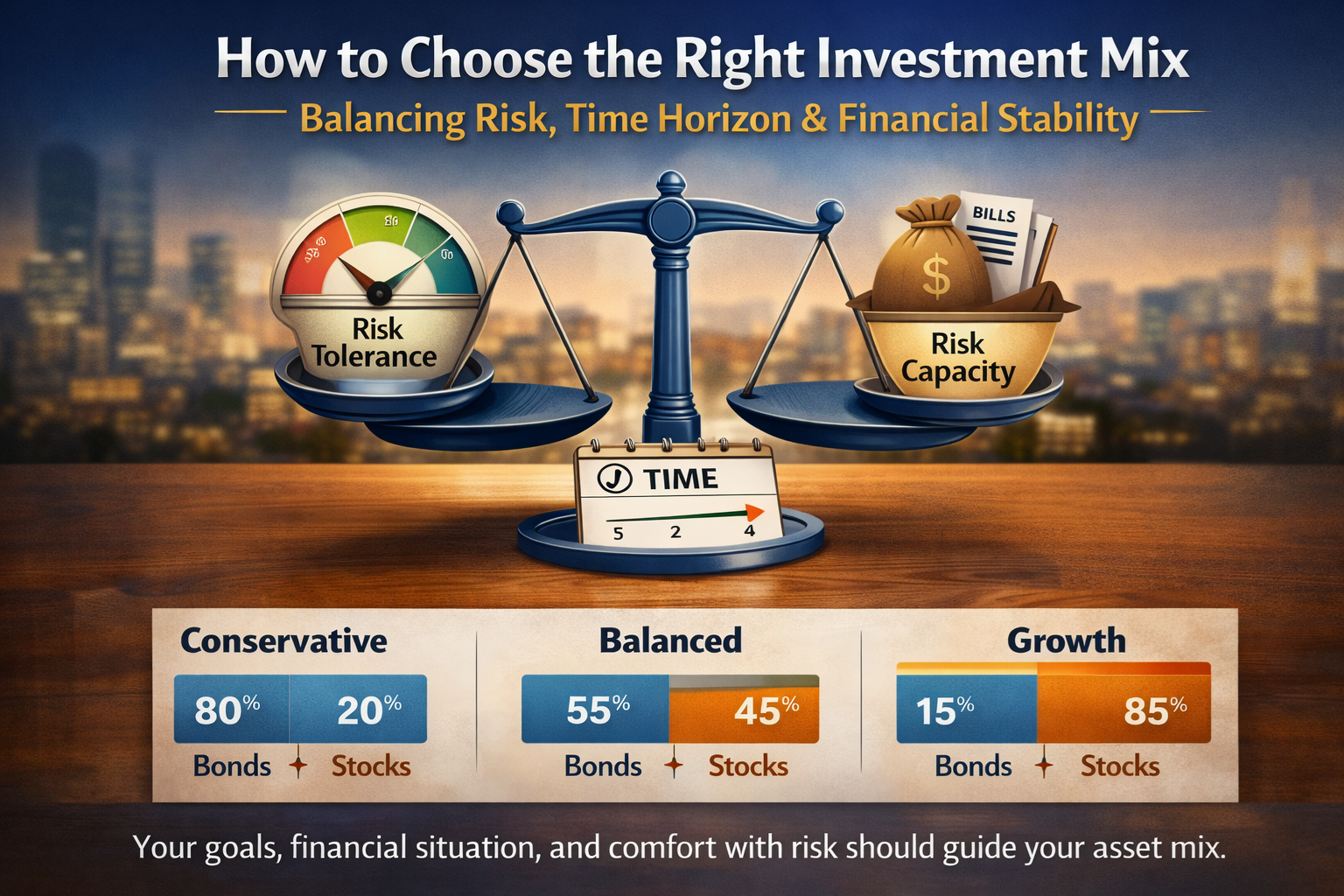
Your financial resilience—your “risk capacity”—is just as important as your risk tolerance. If you may need to sell investments to cover essential expenses, choose a more conservative allocation.
These expenses may include rent. They may also include mortgage payments. They may also include medical costs. On the other hand, investors with strong emergency savings, steady income, and minimal short-term liabilities can afford to accept more market fluctuations.
How long can you remain invested?
Your time horizon dramatically influences your investment choices. A two-year time frame usually calls for a cautious portfolio. It should focus on protecting your money.
A twenty-year time frame allows a more aggressive mix. It can better handle ups and downs in the market. The longer your money can remain invested, the more opportunity you have to recover from downturns and benefit from compounding growth.
Understanding Risk Tolerance: Weathering Market Volatility
Investment risk comes in many forms—interest rate risk, credit risk, liquidity risk—but the type most people associate with investing is market risk: the possibility that the overall market or a particular sector will decline.
Equities, for example, have historically delivered higher long-term returns than bonds or cash equivalents. However, they also tend to experience larger swings in value. Markets rarely increase in a straight line. Prices can rise, fall, plateau, and then recover—sometimes rapidly, sometimes slowly.
Risk tolerance is your comfort level with these fluctuations. If market swings cause stress or anxiety, you may be more likely to sell at a low point, locking in losses and potentially missing the subsequent recovery. Conversely, someone who can tolerate volatility without making emotional decisions may achieve better long-term results.
Financial professionals often use investor questionnaires to quantify risk tolerance. These tools help translate your emotional comfort with risk into a concrete allocation strategy that aligns with your long-term goals.
Risk Capacity: Your Financial Cushion
While risk tolerance reflects your emotional comfort with volatility, risk capacity measures your ability to withstand losses without threatening your financial stability.
For example, consider two investors:
● Investor A has six months of living expenses saved in an emergency fund and a stable job. They can likely afford a higher-risk portfolio with a larger allocation to equities.
● Investor B has little cash savings and works in a volatile industry. Even if they’re psychologically comfortable with market swings, their limited financial buffer makes a high-risk portfolio potentially dangerous.
Evaluating your risk capacity helps ensure that short-term market declines won’t force you into decisions that compromise your goals.
Time Horizon: Planning for the Long Game
Investing is almost always goal-driven. Your time horizon—the length of time before you need to use the funds—plays a critical role in determining how much risk you can take.
Short-term investors may need to focus on capital preservation, keeping most of their funds in lower-risk investments such as bonds or cash equivalents. Long-term investors, on the other hand, can afford to allocate more heavily to stocks, which are volatile in the short term but historically provide higher returns over decades.
For instance, a portfolio with 80% equities may experience sharp declines in a single year, but over 20 years, it historically has the potential to outperform a conservative portfolio with only 20% in stocks. The long horizon allows time to ride out market swings and benefit from compounding growth, which can make a significant difference in achieving goals like retirement or funding a child’s education.
Integrating Risk, Capacity, and Time
The most effective portfolios consider all three factors together. Sometimes they align neatly, and sometimes they conflict:
● You may have the emotional tolerance to endure volatility but lack the financial cushion to survive it.
● Conversely, you may have abundant resources but be naturally risk-averse.
The key is to design a portfolio that balances:
● Your financial goals and time frame
● Your actual ability to handle losses
● Your emotional comfort with market swings
A well-structured portfolio distributes investments among equities, fixed income, and short-term instruments in a way that reflects this balance.
Discipline Is Key
Once your strategy is in place, sticking with it through market cycles is critical. Long-term success often comes less from picking the “perfect” investment and more from keeping a thoughtful mix over time. Attempting to time the market or reacting to short-term volatility usually leads to poorer results than remaining invested for the long haul.
By clearly assessing your risk tolerance, financial capacity, and time horizon, you create a foundation for an investment plan you can maintain—an essential step toward achieving your long-term financial objectives.
Sources:
https://www.fidelity.com/learning-center/personal-finance/risk-tolerance-time-horizon
Disclosure:
This information is an overview and should not be considered as specific guidance or recommendations for any individual or business.
This material is provided as a courtesy and for educational purposes only. A ROTH Conversion is a taxable event. Consult your tax advisor regarding your situation.
These are the views of the author, not the named Representative or Advisory Services Network, LLC, and should not be construed as investment advice. Neither the named Representative nor Advisory Services Network, LLC gives tax or legal advice. All information is believed to be from reliable sources; however, we make no representation as to its completeness or accuracy. Please consult your Financial Advisor for further information.