
The Magnificent 7 Stocks Explained
March 4, 2026
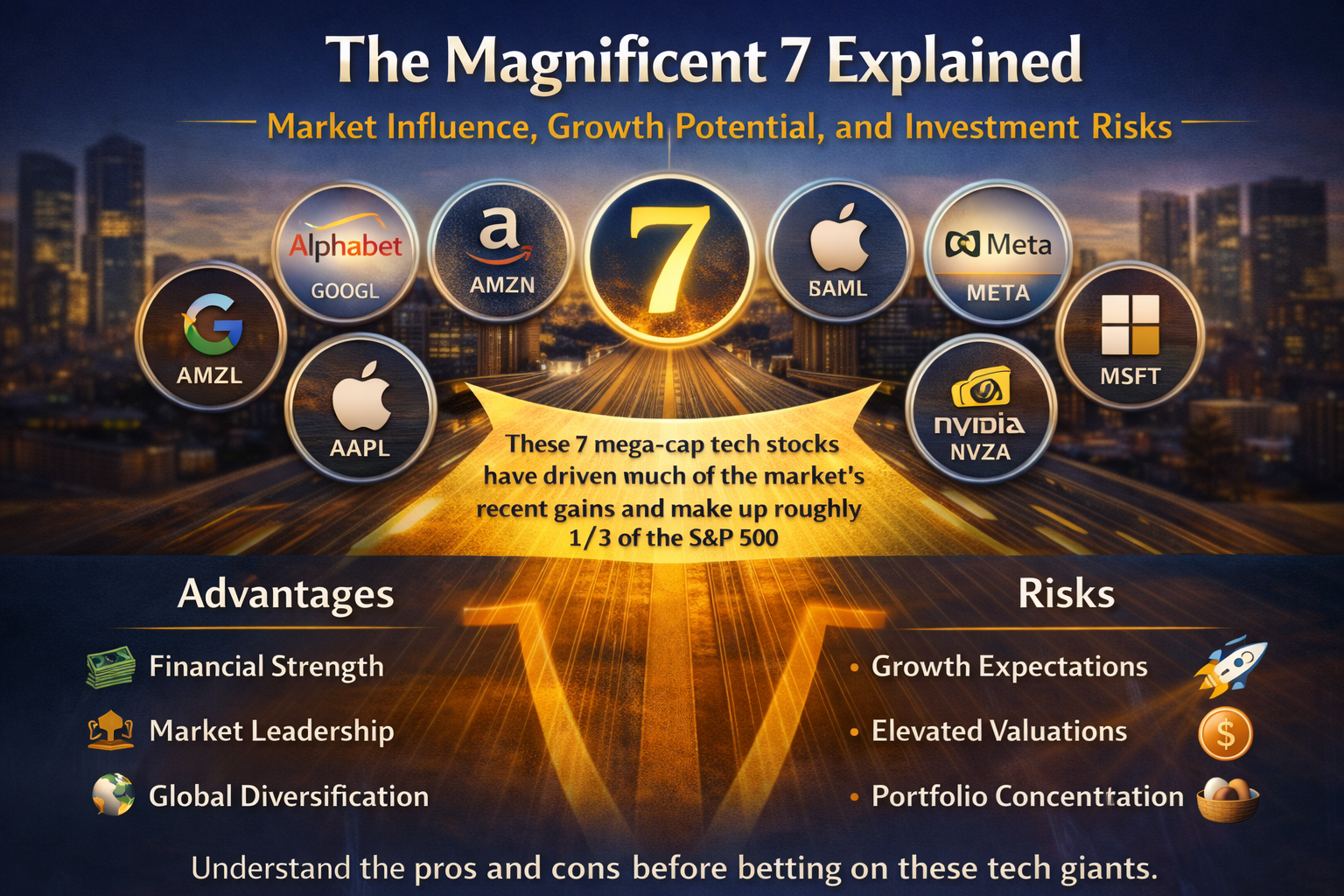
From the earliest days of organized exchanges, investors have tried to identify clusters of companies they believe are poised for exceptional growth. When those clusters capture the market’s imagination, they often earn a catchy label. In the 1960s and 1970s, the “Nifty 50” dominated headlines. Today, the spotlight belongs to a group of mega-cap technology companies commonly referred to as the “Magnificent 7.”
Here’s a closer look at who they are, why they matter, and the potential advantages and risks of investing in them.
What Are the Magnificent 7 Stocks?
The Magnificent 7 refers to seven large-cap technology-oriented companies whose combined size and performance have had an outsized influence on major market indexes. These companies are:
● Alphabet
● Amazon
● Apple
● Meta Platforms
● Microsoft
● Nvidia
● Tesla
These firms are generally classified as large-cap or mega-cap stocks, meaning their market capitalizations rank among the highest in the world. Market capitalization is calculated by multiplying a company’s share price by its total shares outstanding.
Due to their enormous valuations and strong stock performance in recent years, the Magnificent 7 have made up roughly one-third of the total market capitalization of the S&P 500 and have contributed a disproportionately large share of its overall returns. Their influence is also significant within the Nasdaq Composite, given its heavy weighting toward technology companies.
Why the Name “Magnificent 7”?
The nickname is a cultural reference to the 1960 film The Magnificent Seven. In investing circles, it reflects the perception that these seven companies have delivered exceptional growth, particularly during the most recent technology-driven bull market cycles. The label gained traction as their stock performance significantly outpaced much of the broader market.
A Closer Look at the Companies
While grouped together, each company has a distinct business model:
● Alphabet operates Google’s search engine and advertising business, along with YouTube, Android, cloud services, and various emerging technology ventures. It trades under two share classes, GOOG and GOOGL, which differ primarily in voting rights.
● Amazon began as an online bookstore but has evolved into a global e-commerce platform, cloud computing leader (Amazon Web Services), logistics operator, streaming provider, and grocery retailer.
● Apple is a consumer technology giant known for the iPhone, Mac computers, iPad, Apple Watch, and a growing ecosystem of subscription-based services.
● Meta Platforms owns Facebook, Instagram, and WhatsApp, and has invested heavily in virtual and augmented reality technologies.
● Microsoft provides enterprise and consumer software, cloud services through Azure, and owns LinkedIn and other business platforms.
● Nvidia designs high-performance semiconductors and graphics processing units (GPUs), which have become essential for artificial intelligence, data centers, and advanced computing.
● Tesla manufactures electric vehicles and energy products, including battery storage systems and solar technologies, blending automotive and technology innovation.
At various points, each of these companies has reached or exceeded $1 trillion in market value, placing them among the most valuable businesses globally.
Potential Advantages of Investing in the Magnificent 7
1. Financial Strength
These companies generally exhibit strong balance sheets, robust cash flow, and consistent revenue growth. Their scale often allows them to invest heavily in research, innovation, and acquisitions.
2. Market Leadership
Each company holds a dominant or highly competitive position within its industry. Significant brand recognition, customer loyalty, and entrenched ecosystems can create barriers to entry for competitors.
3. Global Diversification
The Magnificent 7 operate internationally, generating revenue from multiple regions. This geographic diversification can help reduce dependence on a single economy and provide exposure to global growth trends.
Risks and Potential Drawbacks
Despite their prominence, investing in the Magnificent 7 carries meaningful risk.
1. Growth Expectations May Be Difficult to Sustain
As companies grow larger, maintaining rapid expansion becomes more challenging. Doubling revenue or market value at multi-trillion-dollar scale is far more complex than doing so as a smaller firm. Investors who concentrate exclusively in mega-cap stocks may miss opportunities in emerging or mid-sized companies.
2. Elevated Valuations
These stocks often trade at premium price-to-earnings ratios, reflecting strong investor optimism. When expectations are high, even minor disappointments in earnings or growth can lead to significant price volatility.
3. Portfolio Concentration Risk
Many large-cap growth mutual funds and ETFs already hold significant positions in these companies. Adding individual shares on top of existing exposure can lead to overconcentration. When a small group of stocks dominates portfolio weightings, overall volatility may increase, particularly if sentiment shifts.
How Investors Can Gain Exposure
There are several approaches to investing in the Magnificent 7:
● Individual stocks: Investors can purchase shares directly through brokerage or retirement accounts.
● Broad index funds: Many funds tracking the S&P 500 or Nasdaq Composite provide indirect exposure because these companies represent substantial portions of those benchmarks.
● Thematic or focused ETFs: Some exchange-traded funds specifically target large-cap growth or even the Magnificent 7 themselves, though these typically carry expense ratios that reduce net returns.
Before investing, it is important to evaluate how additional exposure fits within your broader asset allocation strategy, risk tolerance, and long-term objectives.
Final Considerations
The Magnificent 7 have undeniably played a central role in recent market performance. Their innovation, profitability, and global reach make them attractive to many investors. However, popularity does not eliminate risk. Elevated valuations, concentration exposure, and shifting economic conditions can all impact future returns.
As with any investment decision, diversification and disciplined portfolio construction remain essential. A balanced approach that aligns with your financial goals and risk profile is generally more sustainable than concentrating heavily in any single theme—even one as prominent as the Magnificent 7.
Sources:
https://www.fidelity.com/learning-center/smart-money/magnificent-7-stocks
Disclosure:
This information is an overview and should not be considered as specific guidance or recommendations for any individual or business.
This material is provided as a courtesy and for educational purposes only. A ROTH Conversion is a taxable event. Consult your tax advisor regarding your situation.
These are the views of the author, not the named Representative or Advisory Services Network, LLC, and should not be construed as investment advice. Neither the named Representative nor Advisory Services Network, LLC gives tax or legal advice. All information is believed to be from reliable sources; however, we make no representation as to its completeness or accuracy. Please consult your Financial Advisor for further information.