
Retirement Planning for Seniors: Coordination Matters More Than Ever
February 3, 2026
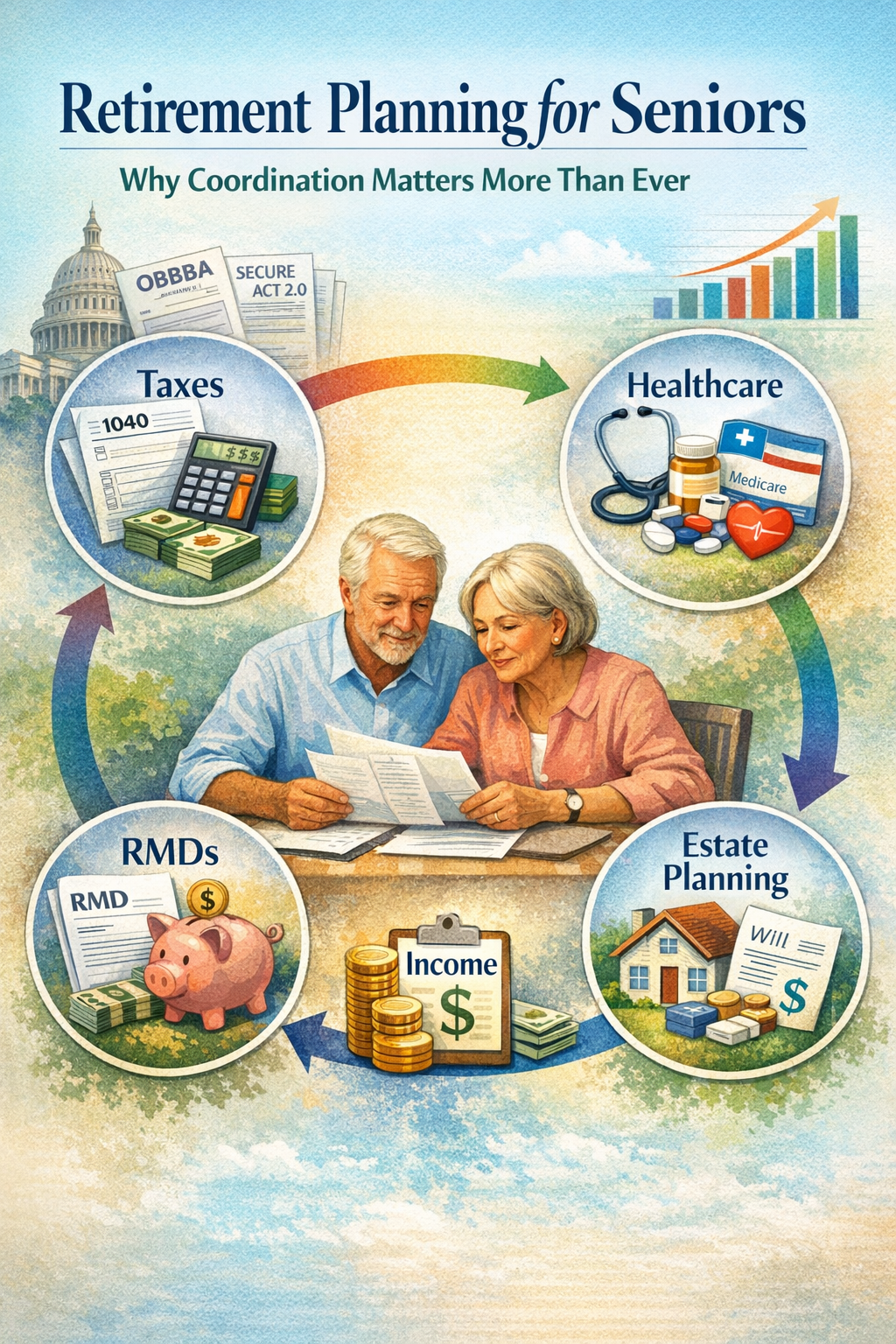
As you move into retirement, financial planning changes in important ways. The focus shifts from saving and growing assets to coordinating income, managing taxes, planning for healthcare, and protecting your legacy. These decisions don’t exist in isolation—each one affects the others, often permanently.
Recent legislation, including the One Big Beautiful Bill Act (OBBBA) and SECURE Act 2.0, provides more clarity around retirement rules. But it also raises the cost of mistakes. Required minimum distributions (RMDs), Medicare premiums, IRMAA surcharges, and healthcare expenses are all tied to income. Small missteps can trigger higher taxes or higher healthcare costs that compound year after year.
Retirement planning in 2026 and beyond requires intentional, multi-year coordination. Below are five planning priorities every senior should revisit as part of a comprehensive financial plan.
1. Use the New Senior Tax Deduction Thoughtfully
Beginning in 2026, OBBBA introduces an additional $6,000 tax deduction per person for individuals age 65 and older, available through 2028. For married couples filing jointly, this can raise the standard deduction to roughly $46,700 in 2026.
However, this benefit phases out based on income. For single filers, the deduction begins to shrink at $75,000 of modified adjusted gross income (MAGI) and disappears at $175,000. For married couples, the phaseout begins at $150,000 and ends at $250,000.
This creates a short window of opportunity. When used carefully, the senior deduction can allow you to recognize additional income—such as Roth conversions or planned withdrawals—without immediately increasing your effective tax rate.
By spreading income more evenly across retirement years instead of waiting for RMDs to force larger withdrawals later, you may be able to:
● Stay in lower tax brackets longer
● Reduce future Medicare IRMAA surcharges
● Preserve valuable deductions and credits
This strategy works best when coordinated with Social Security taxation thresholds and Medicare premium planning.
Planning insight: Think of the senior deduction as a temporary planning tool, not a permanent benefit. Using it strategically can reduce long-term tax and healthcare costs.
2. Rethink Required Minimum Distribution (RMD) Planning
SECURE Act 2.0 has pushed the RMD start age later—now 73 for many retirees, and eventually 75 for those born in 1960 or later. While this delay provides flexibility, it also increases the risk of large, concentrated withdrawals later in retirement.
After several years of strong market performance, many retirees are entering 2026 with larger-than-expected retirement account balances. Larger balances mean larger RMDs—and larger tax bills.
For example, a retirement account that was worth $1 million just a few years ago could easily exceed $1.3 million today. That growth can increase annual RMDs by tens of thousands of dollars, even before accounting for other income sources like Social Security or pensions.
Effective RMD planning isn’t just about calculating the required withdrawal. It’s about shaping income over time. This may include:
● Partial Roth conversions in lower-income years
● Drawing from taxable accounts earlier in retirement
● Coordinating withdrawals across taxable, tax-deferred, and tax-free accounts
● Using Qualified Charitable Distributions (QCDs) for charitable goals
Without coordination, delayed RMDs often collide with other income sources, pushing retirees into higher tax brackets and triggering Medicare premium surcharges.
Planning insight: The goal isn’t to delay RMDs as long as possible—it’s to avoid income spikes that increase lifetime taxes and healthcare costs.
3. Treat Health Savings Accounts (HSAs) as a Retirement Asset
Health Savings Accounts are one of the most powerful—and most misunderstood—tools in retirement planning. HSAs offer a rare triple tax benefit: tax-deductible contributions, tax-free growth, and tax-free withdrawals for qualified medical expenses.
Starting in 2026, OBBBA expands HSA eligibility and flexibility:
● More individuals with ACA Bronze or catastrophic plans qualify
● Telehealth services can be covered before meeting the deductible
● HSA funds can be used for Direct Primary Care memberships
● Contribution limits rise to $4,400 for individuals and $8,750 for families, plus catch-ups
When HSAs are invested and allowed to grow, they can serve as a dedicated healthcare reserve in retirement—helping cover Medicare premiums, copays, deductibles, and other medical expenses. This allows your other retirement assets to remain invested for lifestyle spending.
HSAs also require careful estate planning. They do not receive a step-up in basis, and non-spouse beneficiaries must generally include the entire balance in taxable income.
Planning insight: An HSA works best as a long-term healthcare fund, not a short-term spending account.
4. Make Medicare and IRMAA Part of Your Income Plan
Medicare decisions are becoming more complex, and 2026 is expected to be especially challenging. Many insurers are reducing plan options, narrowing provider networks, or increasing costs. Each fall, Medicare enrollees receive an Annual Notice of Change outlining what will change the following year.
Choosing between Original Medicare with Medigap and Medicare Advantage involves trade-offs:
● Original Medicare with Medigap offers broader provider access and predictable costs
● Medicare Advantage plans often have lower premiums and extra benefits, but introduce network restrictions and prior authorization requirements
At the same time, Medicare premiums are heavily influenced by income through IRMAA (Income-Related Monthly Adjustment Amounts). These surcharges are based on MAGI from two years prior, meaning today’s income decisions affect future Medicare costs.
Higher-income retirees—and especially surviving spouses—can face sharply higher premiums due to IRMAA thresholds and the so-called “widow’s penalty.”
Planning insight: Before executing income-generating strategies like Roth conversions, it’s critical to model the downstream impact on Medicare premiums.
5. Update Estate and Legacy Planning with Taxes in Mind
OBBBA permanently raises the federal estate and gift tax exemption beginning in 2026 to $15 million per person, indexed for inflation. For many families, estate taxes are no longer the primary concern.
Instead, the bigger risks often involve:
● Large inherited IRAs triggering accelerated income taxes
● Surviving spouses facing higher tax brackets and Medicare costs
● Outdated beneficiary designations that no longer align with current law or family goals
For families near the exemption threshold, lifetime gifting strategies may still make sense. Annual exclusion gifts and advanced trust planning can help shift future growth out of the estate. For most retirees, however, income tax efficiency now matters more than estate tax avoidance.
Planning insight: The most common estate planning mistake today isn’t estate tax—it’s inefficient income taxation and poorly coordinated beneficiary outcomes.
The Bottom Line: Retirement Planning Is About Coordination
In retirement, the margin for error narrows. Income decisions affect taxes. Taxes affect Medicare premiums. Healthcare costs affect withdrawal strategy. Estate plans affect heirs.
The most effective retirement plans don’t treat these decisions separately. They coordinate them over time.
Working with a financial advisor who understands how these pieces fit together can help you reduce unnecessary taxes, manage healthcare costs, and protect your long-term financial security—so you can focus on enjoying retirement with confidence.
Sources:
https://timberridgelcs.com/blog/financial-planning-tips-for-seniors-2/
Disclosure:
This information is an overview and should not be considered as specific guidance or recommendations for any individual or business.
This material is provided as a courtesy and for educational purposes only.
These are the views of the author, not the named Representative or Advisory Services Network, LLC, and should not be construed as investment advice. Neither the named Representative nor Advisory Services Network, LLC gives tax or legal advice. All information is believed to be from reliable sources; however, we make no representation as to its completeness or accuracy. Please consult your Financial Advisor for further information.