
Backdoor Roth IRA Strategy and Income Limits
December 29, 2025
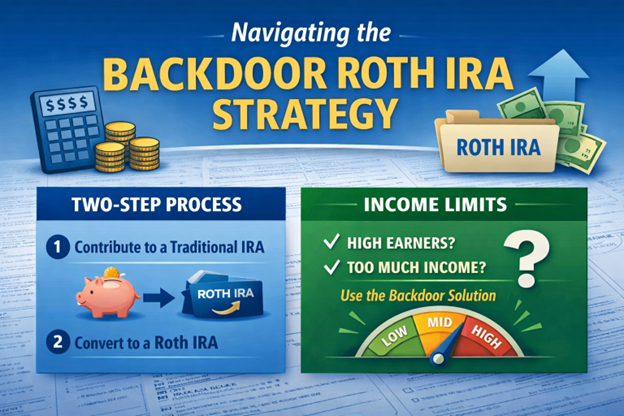
Many people like the idea of contributing to a Roth IRA because qualified withdrawals in retirement are generally tax-free. However, higher earners often discover they are not allowed to contribute directly due to IRS income limits.
There is a lawful workaround known as a backdoor Roth IRA. While it is not a separate type of account, it is a strategy that allows eligible individuals to move money into a Roth IRA even when their income exceeds the normal limits.
At a high level, the backdoor strategy involves two steps:
1. Making a contribution to a traditional IRA
2. Converting that contribution to a Roth IRA
To use this approach effectively—and avoid unexpected taxes—there are several important rules to understand.
IRA Contribution Limits Still Apply
The backdoor strategy does not allow you to exceed normal IRA contribution limits. Each year, your total IRA contributions (traditional and Roth combined) are capped at the lesser of:
● 100% of your earned income for the year, or
● The annual IRS limit
For both 2024 and 2025, the limits are:
● $7,000 for individuals under age 50
● $8,000 for individuals age 50 or older (includes a $1,000 catch-up contribution)
Why High Earners Cannot Contribute Directly to a Roth IRA
Unlike traditional IRAs, Roth IRAs have income restrictions based on your modified adjusted gross income (MAGI) and tax-filing status.
2025 Roth IRA Income Limits (MAGI)
● Single / Head of Household
● Up to $150,000: full contribution
● $150,000–$165,000: partial contribution
● $165,000 or more: no contribution
● Married Filing Jointly / Qualifying Widow(er)
● Up to $236,000: full contribution
● $236,000–$246,000: partial contribution
● $246,000 or more: no contribution
● Married Filing Separately
● Less than $10,000: partial contribution
● $10,000 or more: no contribution
Tip: If your income falls in the “partial” range, you may still contribute some amount directly to a Roth IRA and place the remainder of your annual limit into a traditional IRA.
2026 Roth IRA Income Limits (MAGI)
● Single/Head of Household
● Up to $153,000: full contribution
● $153,000-$168,000: partial contribution
● $168,000 or more: no contribution
● Married Filing Jointly/Qualifying Widow(er)
● Up to $242,000: full contribution
● $242,000-$252,000: partial contribution
● $252,000 or more: no contribution
● Married Filing Separately
● Less than $10,000: partial contribution
● $10,000 or more: no contribution
Traditional IRA Contributions: Deductible vs. Nondeductible
Traditional IRAs do not have income limits for making a contribution, but income and workplace retirement plan coverage can limit whether that contribution is tax-deductible.
If you or your spouse participate in an employer retirement plan, the deductibility of your traditional IRA contribution may be reduced or eliminated as your income rises.
Because Roth IRAs are funded with after-tax dollars, many people intentionally treat the traditional IRA contribution used for a backdoor strategy as nondeductible, even if they technically qualify for a deduction.
That said, this decision should be made carefully, particularly if you already have money in traditional IRAs.
How the Backdoor Roth IRA Works in Practice
A backdoor Roth IRA generally follows this sequence:
Make a contribution to a traditional IRA
● This must be completed by the tax-filing deadline (typically April 15 of the following year).
● Extensions do not extend the IRA contribution deadline.
Convert the contribution to a Roth IRA
● There is no formal deadline for the conversion.
● Many people convert soon after contributing to limit taxable investment growth in the traditional IRA.
Once the funds are in the Roth IRA, future qualified withdrawals may be tax-free.
The Pro-Rata Rule: A Common Surprise
If you already have pre-tax money in traditional IRAs, SEP IRAs, or SIMPLE IRAs, the IRS requires that any Roth conversion include a proportional mix of pre-tax and after-tax dollars. This is known as the pro-rata rule.
Example
● You have $95,000 in traditional IRAs, all pre-tax
● You make a $5,000 nondeductible contribution
● Your total IRA balance becomes $100,000
● You convert $5,000 to a Roth IRA
Because only 5% of your IRA balance is after-tax, only 5% of the conversion is tax-free. The remainder is taxable—even though the contribution itself was nondeductible.
This rule is often the biggest obstacle to an efficient backdoor Roth strategy.
Using an Employer Plan to Reduce Taxes
Some individuals can avoid the pro-rata issue by rolling pre-tax IRA balances into an employer retirement plan, such as a 401(k), if the plan allows incoming rollovers.
Continuing the example above, if the $95,000 pre-tax balance is rolled into a 401(k), only the $5,000 after-tax contribution remains in the IRA—allowing for a fully tax-free Roth conversion.
Important reminders:
● Employer plans generally cannot accept after-tax IRA dollars
● Required minimum distributions must be taken first, if applicable
● No new rollovers from an employer plan into an IRA should occur in the same year
Always confirm plan rules before pursuing this approach.
Proper Tax Reporting Is Critical
Backdoor Roth IRA contributions must be reported correctly on your tax return. IRS Form 8606 is used to track nondeductible IRA contributions and Roth conversions, ensuring you are not taxed twice on the same dollars.
Failure to file Form 8606 when required can result in:
● Double taxation
● IRS penalties for incorrect or missing reporting
Because custodial tax forms are issued on different timelines, your tax preparer may need account statements—not just Forms 1099-R and 5498—to complete your return accurately.
Final Thought
A backdoor Roth IRA can be a powerful planning tool for higher earners, but it is not a “set it and forget it” strategy. Income limits, existing IRA balances, employer plan rules, and tax reporting all play a role in determining whether it makes sense for you.
Before implementing this strategy, it is wise to coordinate with both your financial advisor and tax professional to ensure the steps are executed correctly and aligned with your broader financial plan.
Sources:
https://districtcapitalmanagement.com/mega-backdoor-roth/
https://www.fidelity.com/learning-center/personal-finance/backdoor-roth-ira
Disclosure:
This information is an overview and should not be considered as specific guidance or recommendations for any individual or business.
This material is provided as a courtesy and for educational purposes only.
These are the views of the author, not the named Representative or Advisory Services Network, LLC, and should not be construed as investment advice. Neither the named Representative nor Advisory Services Network, LLC gives tax or legal advice. All information is believed to be from reliable sources; however, we make no representation as to its completeness or accuracy. Please consult your Financial Advisor for further information.